Let’s talk about something a lot of us feel but rarely say out loud: that ache when it comes to our mothers. Maybe it’s a longing that never quite gets filled. Maybe it’s grief you didn’t know you had and can’t fully name. Maybe it’s that exhausting loop of chasing her approval, or bracing yourself for her criticism, even now, even as an adult.
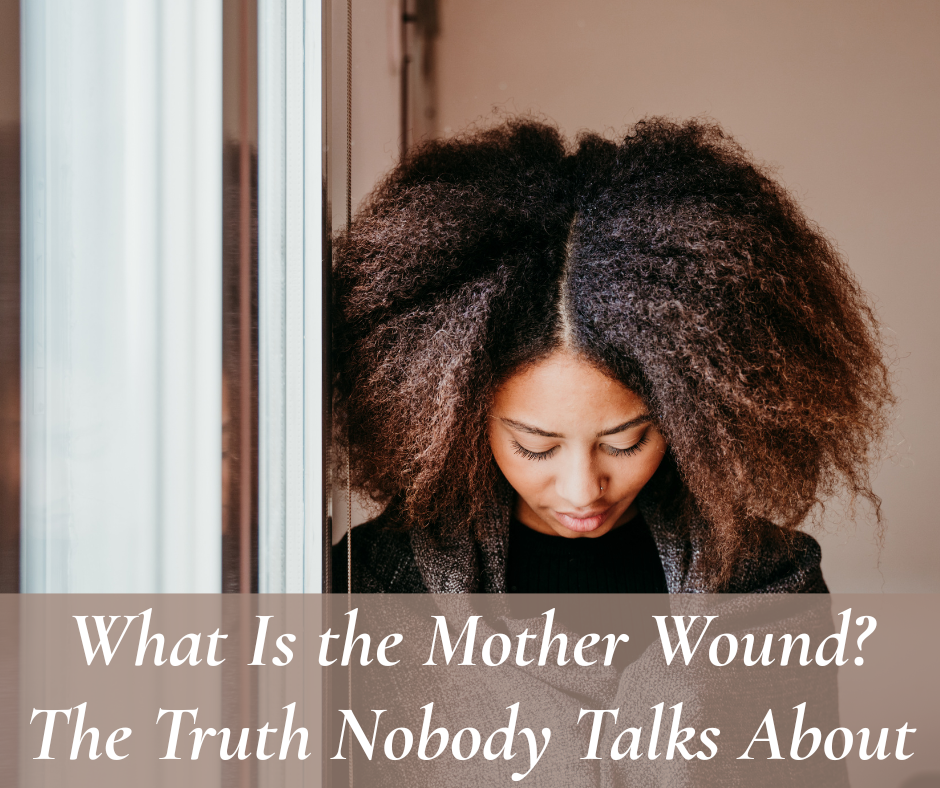
If any of that sounds familiar, you might be carrying what’s often referred to as the mother wound.
I want to be really clear up front: this isn’t about blaming your mom. It’s about finally understanding what actually happened so you can stop carrying it on repeat and heal it for good.
So What Is the Mother Wound, Really?
The mother wound is the pain that gets handed down from mother to daughter, generation after generation, when a mom simply wasn’t able to fully meet her daughter’s emotional needs. Not because she didn’t love her. Because she was never given what she needed to be able to show up that way.
You might recognize it as:
- Trouble trusting your own feelings and gut instincts
- Chronic people-pleasing, or a low-grade fear of letting people down
- An ache for nurturing you can’t quite trace back to its source
- Anxiety in close relationships — fear of being abandoned, or fear of losing yourself
- A harsh inner critic that sounds a little too familiar
- Guilt around rest, receiving love, or being cared for
- Swinging between over-caretaking everyone around you, or avoiding it completely
Here’s the thing about the mother wound: it’s rarely one big dramatic event. It’s more like a pattern, theme, or coping methods that get quietly passed down, that nobody chose consciously until someone finally decides to look at it. I mean really look at it and ask questions, like what is causing her to behave like this? is she projecting her own pain?
Here’s the Part Nobody Talks About: Mothers Can Only Give What They Were Given
This is the piece of the conversation that gets skipped way too often, and honestly, it’s the piece that changes everything:
A mother can only mother to the limit of the emotional, practical, and financial support she herself received.
Sit with that for a second. Being emotionally attuned. Being patient. Being able to regulate your own nervous system while soothing a screaming baby at 3am. Modeling healthy boundaries and self-worth. None of that is something you’re just born knowing how to do. It has to come from somewhere from having been mothered well yourself, from having a partner or a community to share the load with, from having enough money that you’re not in constant survival mode, from having rest and real support. When those things are missing, mothers aren’t choosing to fall short. She’s parenting from a well that was already running dry, often long before you were born.
The Wounding Isn’t Just About Her — It’s About the Systems She Was Living In
Here’s where I want to gently reframe things: the mother wound isn’t just the story of one imperfect woman. It’s the story of the systems that woman was raised inside of, and expected to parent inside of.
Think about what most mothers are actually up against:
- Economic systems that offer barely any paid leave, unaffordable childcare, and wages that force impossible choices between being present and putting food on the table
- Cultural messaging that praises self-sacrifice in mothers while giving them almost no support, rest, or mental health care in return
- Her own unhealed wounds — the ones she inherited from her mother, who inherited them from hers
- Old-school expectations that dumped all the emotional labor of raising kids onto one person, without the village humans actually need
- Isolation — we ripped mothers away from the extended family and community structures we evolved to raise children within, and then acted surprised when they burned out alone
A mother parenting in survival mode — exhausted, under-resourced, unsupported, unhealed — is going to pass some of that on. Not because she’s a bad mom. Because nobody can pour from a cup that was never allowed to fill up.
I’m not saying this to erase what you went through. Your pain is real. Not feeling fully seen or soothed or supported — that mattered, and it still matters. But understanding why it happened, understanding that it was never actually about your worth, is often the door that healing walks through.
Mothers Are People Too
This might be the most important sentence in this whole post: mothers are people too.
Before she was your mother, she was — and still is — a full human being. A person with her own personality, her own wounds, her own unmet needs, her own dreams that may or may not have come true. Motherhood is a role she holds. It was never meant to erase the rest of who she is.
Somewhere along the way, a lot of us absorbed the idea that a “good mother” disappears into the role completely — that her needs, her voice, her identity should quietly fold into ours. And when a mother is expected to lose herself like that, one of two things tends to happen: she does lose herself, and resentment or emotional dysregulation seeps into the relationship. Or she doesn’t, and she gets labeled selfish for simply remaining a person.
Here’s why this matters so much: when a mother is allowed to retain her own identity as a person alongside her role as a mother, it takes the daughter off the hook for managing her mother’s unmet needs and unspoken voice.
If you’ve spent years feeling responsible for your mother’s happiness, her loneliness, her disappointments, or the dreams she never got to chase that’s not a role that ever should have landed on you. Her personhood, her healing, her voice those belong to her, not to you. You were her child. You were never meant to be her therapist, her partner, or her second self.
Letting your mother be a full person flawed, complicated, unhealed in her own ways isn’t about excusing what happened. It’s about handing responsibility back to where it actually belongs, so you can eventually set down what was never yours to carry.
Why Understanding This Matters
When you understand the mother wound this way as something shaped by limited resources and bigger systems, not just one woman’s failures two things become possible at once:
- You get to grieve what you didn’t get, without needing to hate the person who couldn’t give it to you.
- You get to stop waiting for her to become someone new, and start giving that to yourself instead.
That second one is where your power actually lives and it’s exactly what we dig into in the next post: how to actually heal the mother wound, step by step.
Ready to go deeper? Book a Complimentary Call and let’s talk about what healing could look like for you.